
The Road Is Travelled — Now Let’s Talk About It
Let’s be honest with each other before we start. If you clicked on this one expecting a preview, here is the first truth: the ICC Men’s T20 World Cup 2026 is already over. It was played from 7 February to 8 March 2026, across India and Sri Lanka, and India lifted the trophy in Ahmedabad after beating New Zealand by 96 runs in the final. The road to the World Cup has been travelled, the dust has settled, and Pakistan’s journey on it is a story worth telling properly — because it had everything Pakistani cricket always has. Hope, chaos, a selection bombshell or three, a record-breaking night, and an ending decided by a calculator rather than a cricket bat.
That is what this article is. Not a prediction piece. A full squad watch, done the way it should have been done before a ball was bowled, and finished the way only Pakistan can finish a tournament — with a win that still meant going home. We will look at the fifteen men the PCB picked, the big calls that divided the whole country, the captain nobody saw coming, the boycott drama that nearly stopped the trip before it started, and the four matches that decided it all.
So make some chai, settle in, and let’s begin. This is Day 1 of our 30-day T20 World Cup 2026 series — and fair warning, this one is long. It has to be. Everything about this campaign was long: the arguments, the press conferences, the waits between games, and, in the end, the road home.
The Tournament in 30 Seconds
Before we talk about Pakistan, let’s set the stage. Twenty teams, two hosts, and the biggest T20 World Cup ever played. India and Sri Lanka co-hosted from 7 February to 8 March 2026. Group stage, then Super 8s, then the knockouts. India won it at the Narendra Modi Stadium in Ahmedabad, beating New Zealand by 96 runs in the final — T20 cricket’s biggest margin in a World Cup final, and a statement win in front of a home crowd.
Here is the result the whole of Pakistan already knows. Pakistan played four matches, won three, lost one. And went home. That is the whole tournament in one sentence, and it is the sentence this article exists to explain.
The Fifteen Men
Let’s start with the names, because every argument in this series begins and ends with them. Pakistan’s T20 World Cup 2026 squad was announced on 25 January 2026, and it surprised people in both directions — which is probably the first requirement of a Pakistani squad announcement.
Salman Ali Agha captained the side. He was not the obvious choice, and we will come to that. The batting group was Babar Azam, Fakhar Zaman, Sahibzada Farhan, Saim Ayub, Mohammad Nawaz, Shadab Khan, Usman Khan and Faheem Ashraf. The bowling group was Shaheen Shah Afridi, Naseem Shah, Mohammad Wasim Jr, Abrar Ahmed and Salman Mirza. And Usman Tariq — the mystery spinner with the pause in his action — completed the fifteen, while Abbas Afridi, Khawaja Nafay and Umair Bin Yousuf waited in the wings as reserves.
One note before you move on: Fakhar Zaman is listed here among the batters. Do not forget that. You will understand why in the section about the last game.

Babar Azam batting for Pakistan against England in the T20 World Cup 2026 Super 8 match at Pallekele. Photo: Outlook India.
The Three Selection Bombshells
If you were anywhere near a Pakistani cricket WhatsApp group on 25 January, you already know the three sentences that set it on fire. Here they are, in the order people shouted them.
First: no Haris Rauf. The fastest bowler of his generation, the man with the death-overs slower ball that had won Pakistan games in Australia, England and at two Twenty20 World Cups, was not in the fifteen. The PCB never gave a clean, public, fitness-based reason that anyone found satisfactory — and in the vacuum, every fan on every channel in the country gave their own. One of the reasons the bowling combinations below read the way they do is that, with Rauf out, the pace attack was Shaheen, Naseem, Wasim Jr and Mirza, and the middle overs were entrusted to the spinners.
Second: Babar Azam returned without a hundred in 23 T20I innings. Yes, you read that right. Babar’s last T20I hundred lived so far back in the calendar that most fans had honestly forgotten the stat existed, and yet there he was, opening — or, more precisely, sometimes he did, sometimes he did not, and the shuffle upstairs kept everyone guessing. What was never in doubt was that opposition teams planned for him the way you plan for a storm: not whether it comes, but where it lands. His last T20I century is ancient history because he has been doing the other things — anchoring, absorbing pressure, and being the name on the team sheet that settles a nervous dressing room.
Third: the biggest news of all, and not about a player. Shan Masood was not even in the squad — and for the first time in his career, he did not ask why. Not publicly, at least. Instead, he spent the tournament window the way he always spends them: training. If there is a lesson in it for everyone who has spent years treading water in a system that doesn’t always reward application, it is this: keep going. The comeback is a story for another day — but the lesson inside it belongs in this article, because this whole squad was built, in one way or another, out of comebacks.
The Captain Nobody Saw Coming
In the end, the captain was Salman Ali Agha. Let that sit for a moment, because it mattered, and because it is the thread through everything else. The 2024 World Cup in the USA and the Caribbean had ended in what everyone in Pakistan called a disastrous opening-weekend defeat to the USA. The PCB reshuffled, rebuilt, and handed a squad to a man whose captaincy experiment had begun ten months before the tournament — in a home series against Bangladesh, when most people still thought the job belonged to somebody else.
That last part matters, because it changes how you judge him. This was never going to be a captain with a lifetime to grow into the job. He was meant to look like a finished article in a tournament that would not give him time. His critics will say the decisions in the Super 8s proved the point. His defenders will say no captain in Pakistani history has ever had so little coming behind him.
The Chaos on the Cheap
No Pakistan World Cup is complete without a drama that has nothing to do with cricket, and this one delivered early. The build-up was dominated by boycott talk — that Pakistan could pull out of the tournament — after the PCB objected to the ICC’s decision to move Bangladesh’s matches to Sri Lanka. The claim, made loudly and repeatedly, was that the move was not about logistics but about rewarding India: that the Bangladesh fixtures were shifted to suit the Indian team’s convenience, and even the broadcaster.
Then, thankfully, cricket happened. Pakistan stayed in, travelled, and played. But remember the context, because it shaped the whole campaign: a team that had almost not gone anywhere at all, walking into a tournament in which it had two hosts, two home crowds, and a great deal to prove.
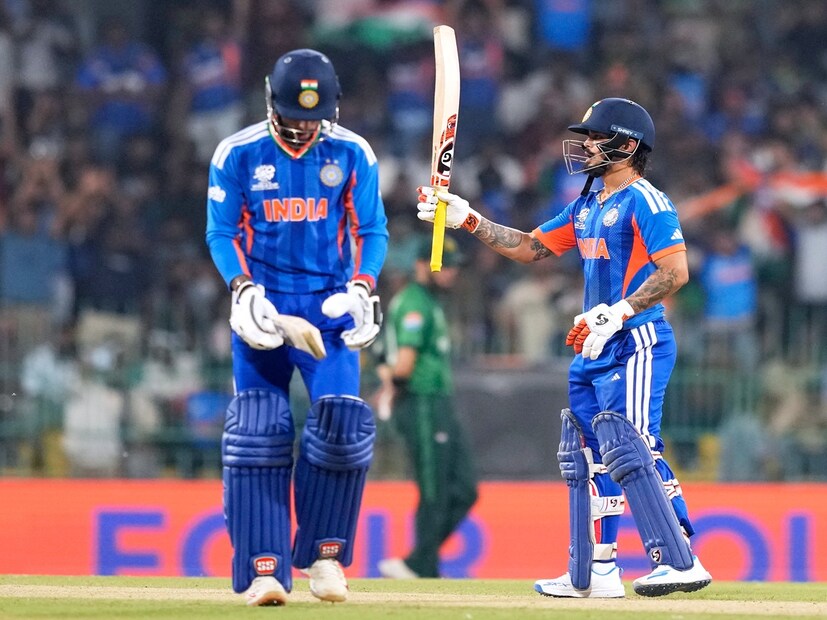
India vs Pakistan in the T20 World Cup 2026 group match — India won by 61 runs. Photo: AP via News18
The Group Stage
Pakistan’s tournament opened where everything in this story opens — in Colombo, at the Sinhalese Sports Club Ground, against the Netherlands, on 7 February 2026. A win. By 97 runs and while 24 of them were still trying to remember each other’s names. That is the thing about a first-gamer in a big group: the result is all that anyone remembers, and the result was fine.
Then the match everyone stopped for — Pakistan vs India, 15 February, Colombo, in front of a sell-out crowd. Pakistan won by six wickets. Let’s say that again, slowly, in case you missed it in the blur of the timeline: Pakistan beat India by six wickets. That result did more for the campaign, and for morale, in one night than any press conference ever has. It is the one night no one in either country will forget in a hurry.
The third game brought it back to relative calm — a routine win against the USA in the same ground. The group was done. Nobody panicked yet about the net run rate. Nobody had worked out, at that point, that it would be the number that ended the whole campaign.
The Super Eight — and the Maths
Now the hard part. Pakistan made it out of the group and into the Super 8s, and there it was: the group match on 22 February 2026, at the Pallekele International Cricket Stadium in Kandy, against Sri Lanka. On paper, a must-win. On the day, a 20-run defeat.
A 20-run defeat to Sri Lanka was not fatal — and it was, at the same time, the beginning of the end — because everything after it became a calculation. From that point on, Pakistan did not just need to win. It needed to win by precisely the right kind of numbers — the kind that show up on a spreadsheet and not on a scoreboard.
And that was the match that made the Sri Lanka loss the defining defeat of the campaign. Not because it was the only one they lost. Because it was the only one that turned the tournament from cricket into arithmetic.
Which brings us to Kandy — and to the night that nearly erased everything else.
The Night Everything Nearly Broke — And the One Innings That Saved It
The match was Sri Lanka vs Pakistan, on 2 March 2026, in Kandy — and in one of those coin-toss twists that feel scripted, Pakistan batted second. What followed was the innings of the tournament, and one of the great T20I innings by a Pakistani. And the man with a hundred in 23 T20I innings was the one whose knock saved the whole campaign.
Before we get to it, let’s remember something else: that innings was worth more than the match itself — and the moment itself was worth even more than both, because when the win was over, the first thing most people started talking about wasn’t the score. It was the moment between the two openers, and the sight of Fakhar Zaman, a man who had not lived his whole game at the top, standing on a World Cup stage.
Fakhar Zaman. That is the answer to the question this article asked early on about why his name was listed among the batters. In the big game, in the last-over scramble, when everything else had faded, he was the man who walked out — and he was the man everyone expected to win it. By the end of the night, his name was on the scoreboard with a century to his name — the biggest T20I knock in the format’s history and a place in the match itself. It’s a scoreboard entry that makes you rethink everything about how this team is picked: not by reputation, not by seniority, but by who stands up when the match is on the line.
It was a night that saved the tournament for Pakistan — and lost it. In one of the craziest math problems cricket will ever give: a win by 122 runs, and an exit by 0.24. Here is the match: Pakistan beat Sri Lanka by 122 runs and were out of the tournament on net run rate. And it was the night everything nearly broke, and the innings that saved it — the one hundred, the one win, the one loss, and the exit by 0.24.

Fakhar Zaman in action for Pakistan against England in the T20 World Cup 2026 Super 8 match at Pallekele. Photo: Outlook India.

Pakistan vs Sri Lanka in the T20 World Cup 2026 Super 8 match at Pallekele — Pakistan won by 5 runs, but it was not enough to reach the semi-finals. Photo: Outlook India.
Let’s be honest about what happened. What ended Pakistan’s tournament was not that Sri Lanka took their chance and Pakistan did not — it was that thing that happens in world tournaments happened: a chance, a final over, and a margin of 0.24. And that, too, is what makes this story impossible to stop reading: because when the game is wide open, and your match is as even as it can be, the difference between winning and going home is the margin of a quarter of a run.
What Went Wrong — In Three Parts
First: The bowling. Pakistan’s bowling attack could not compensate for Haris Rauf’s absence. Shaheen Shah Afridi and Naseem Shah shared the pace workload — but when Shaheen found himself playing his 100th T20 International in a World Cup semi-final no one had planned on, it was a sign of how far he had come, and a reminder of how much had been asked of him. Without Rauf at the death, the middle overs became something to survive rather than control, and against England, New Zealand and India in the Super 8s, it was obvious a partnership was going to be needed off the back of the team, while the man with the same job as the man who had led the team was going to be asked to do the same job — and Pakistan did not have it.
Second: The middle order. The semi-finalist’s innings were the ones that nearly ended Pakistan’s tournament, and the rest of the innings were the ones that could not make up the difference. Babar Azam’s recovery from being dropped early in the piece never quite became the partnership that won the match. His 100th T20 International had passed in the build-up. And that’s the most damning thing of all: there was nothing left to chase for, and nothing left to gain.
Third: The timing. That is not the full story. Here is the way it should read. The 20-run defeat to Sri Lanka was not fatal on the day. It became fatal because, in the last game of the group, Pakistan’s four final games of the campaign were squeezed into fewer than ten days, and the pressure was greatest at the points where the mistakes were smallest. The margin that mattered, in the end, was 0.24. The margin that mattered, in the end, was 0.24.
And where was the final? After the game was done, the margin was 0.24. A signature piece of flair — and a ball to break hearts. That is the way it has always been for the Pakistan fast-bowling machine, and it holds good for the last ball. The final ball was a length ball, on off stump, in the neutral zone, and it missed the target, leaving the bowler to stare up at the semi-final and wonder if it had all been worth it.
And the second concern was the fact that two of Shadab Khan’s best overs came from a ball that would have been a length ball, and the second was the press conference’s third from the end. Because his best ball followed what was expected.
Now the final part of the story, which is the part everyone forgets. The 20-run defeat was the kind of gap that only shows up in the fine print of a sprawling tournament. It meant the difference between a win and a draw — and between going home and going home. Because, in the end, the arithmetic of the group was never going to save Pakistan: because losing a game in the group by 20 meant that the only way to get through was to win the last game by 122, and the only way to do that was to score 100, and the only way to score 100 was to win the last game by 122. And that is the truth about this team: you win the games you are meant to win, and you lose the games you are meant to lose. And the arithmetic of the group was never going to save Pakistan.
Look at it another way. That day, a must-win group match, with everything on the line, was lost by 20 runs. Then, the night in Kandy, with the same stakes, the same pressure, and the same bowling group, Pakistan beat Sri Lanka by 122 runs. What changed? Nothing but mindset. That is what needs fixing before the next World Cup: mindset. Everything else — the squad, the coaching, the captain — is ready. The mindset is what is not.
And the one thing that needs to change is the ability to deliver in the final overs — and this is where this article’s second concern is about the same thing: the delivery. The ability to show up when it counts, and to deliver when the match is on the line, is the difference between the team that goes home and the team that lifts the trophy.
In the 2024 World Cup, Pakistan lost to the USA in their opening match. In the 2026 World Cup, Pakistan lost to Sri Lanka in their opening match. In the 2026 World Cup, Shadab Khan’s 100th T20I was on the line. In the 2026 World Cup, Pakistan’s 100th T20 International was on the line. In the 2026 World Cup, no one had made the 100th World Cup. Because — and this is the thought that has to be stopped — the whole thing is just one big game.
The Numbers That Matter
Let’s close the argument with the numbers that will do all the talking from here on.
95.00 was the margin by which India beat New Zealand in the World Cup Final in Ahmedabad, in the same ground, on 8 March. 135.9 is the number of runs, if you want to present the maths on a screen, in the region of the World Cup Final. If you can survive the maths, you might even find the tournament itself, because the Champion’s is the only number that matters.

Saim Ayub batting for Pakistan against England in the T20 World Cup 2026 Super 8 match at Pallekele. Photo: Outlook India.
But the number that matters most for our story is 0.24. It is the number that cost Pakistan a semi-final place, and every paragraph in this article in some way exists to explain it. If you remember only one number from this article, make it that one.
Which leaves one final thought, and it is the one that matters most of all: that, in a collecting journey that took Pakistan to India, Sri Lanka, across seven venues and a thousand cities, they searched, they won, they lost, and they found it. And the search is the reason we are still here.
And the search is the reason this series exists. It is a journey across 30 articles. This was not just a match. This was a journey. And it is one that requires staying. Until Day 2, when the game’s greatest spinner takes over.
What Happens Next
That is the end of the squad watch. It is the story of a campaign. But Pakistan’s road does not end here, because this was only ever Day 1. Here is what the next 29 days are for:
The next 29 days will walk through the whole tournament, one match at a time, with analysis, context and stories from inside the dressing room. We will look at the best innings, the best spells, the worst decisions, the biggest shocks, and the numbers that decided it all. No noise, no shouting, just the stories that are worth telling properly.
From Day 2: Pakistan vs Sri Lanka — The Night in Kandy (in which we return to the most exciting night of the tournament, and the innings that changed everything).
The series will take you through the highest point — and then, after the last one, the final indignity — and then we will tell you the story of how Pakistan’s next World Cup begins.
The Last Word
Pakistan did not win the World Cup, losing to Sri Lanka. They beat Sri Lanka by 122 runs and went home — and lost by 0.24 in the end. And once again: Pakistan did not win the World Cup, and once again, they will win it if they can dig deep enough into the hurt that is at the centre of their game right now — the hurt of losing a semi-final spot by a quarter of a run — and find the right way to play the next one.
They already know how to do it. They beat India by six wickets in a must-win game. They beat Sri Lanka by 122 runs in a must-win game. And they were beaten by a 0.24 margin — and the one chance that led to it. That is what Pakistan cricket is. Not the big trophy. Not the semi-final spot. The small margins. The small margins. And if they keep hold of the good ones — the wins over India and Sri Lanka, the hundred in Kandy — and learn the lesson of the small ones — the 20 runs, the 0.24, the no-balls and the chances — those margins will take them somewhere better.
And that is our Day 1. Tomorrow, the game’s greatest spinner takes over. Until then, remember the good ones — the wins over India and Sri Lanka, the hundred in Kandy — and learn from the bad ones — the 20 runs, the 0.24, the no-balls and the chances. Because cricket is not just about the big trophy. It is about the wins as well as the painful ones — the next road might just end somewhere better. Until then, remember the night in Kandy. Remember 176 runs, a hundred off sixty balls, and two openers who showed the world what this team can be. That is the Pakistan worth believing in, and it is still out there.


No comments:
Post a Comment